
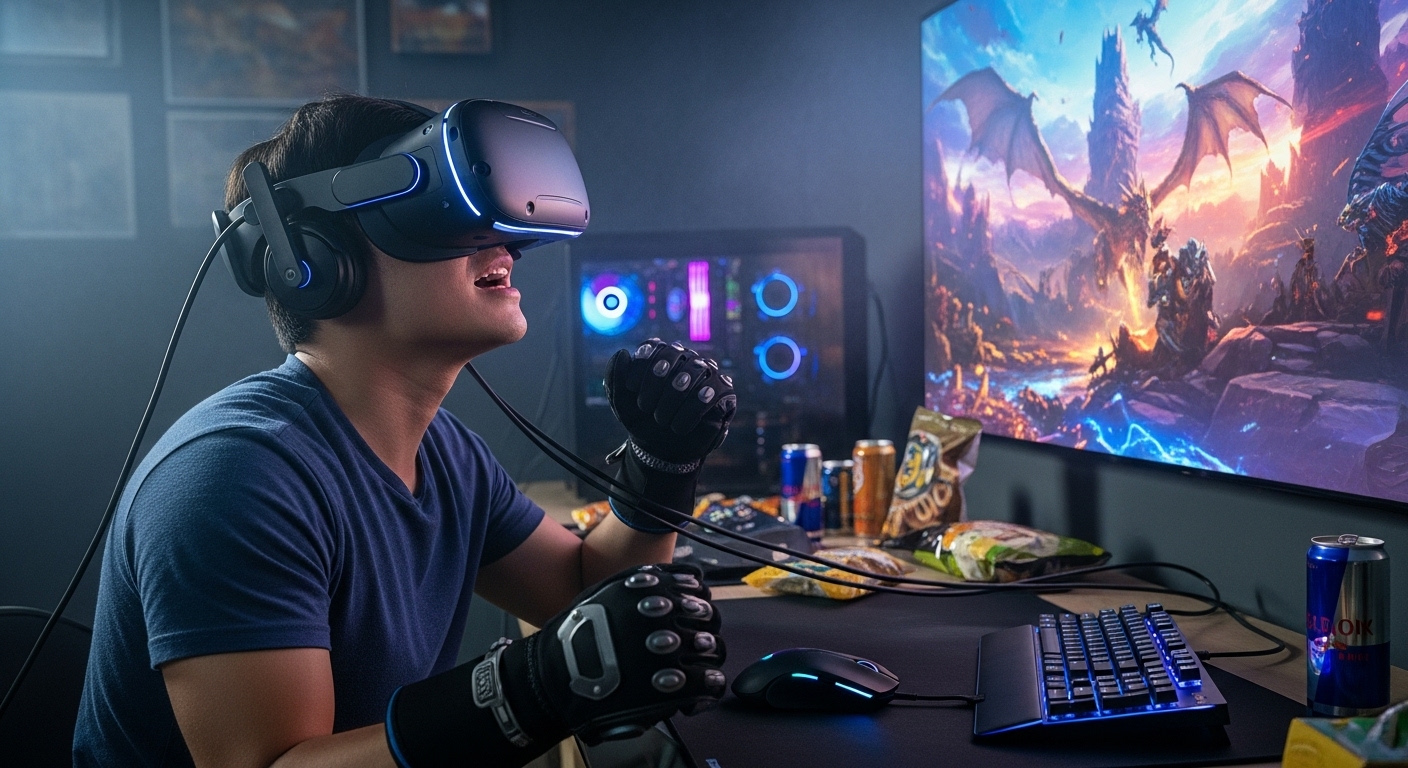
Video games have become a significant part of modern culture, offering entertainment, social connection, and even career opportunities. What was once a simple pastime has evolved into a multi-billion-dollar industry, with millions of players worldwide, diverse genres, and cutting-edge technology. But how did gaming evolve into what it is today? What makes it such a dominant force in global entertainment? In this blog post, we will explore the history, technological advancements, cultural impact, and future of gaming.
The Early Days: The Genesis of Video Games
The birth of video games can be traced back to the mid-20th century when computers were still in their infancy. The concept of interactive electronic entertainment emerged from the world of experimental computing, with early prototypes resembling games more than anything that could be classified as entertainment.
One of the earliest examples was Tennis for Two (1958), developed by physicist William Higinbotham. This game was designed as a demonstration of the technology in a physics lab at the Brookhaven National Laboratory. However, it was Pong (1972) that truly began the commercialization of video games. Created by Atari’s founder Nolan Bushnell, Pong was a simple ping-pong game that became an instant hit in arcades and is often credited with the beginning of the video game industry.
Following Pong, a series of arcade games like Space Invaders (1978), Pac-Man (1980), and Donkey Kong (1981) began to gain popularity. These games were simple, yet addictively fun, providing a new form of entertainment that captivated millions and laid the foundation for future developments in the gaming world.
The Rise of Home Consoles: Gaming in the Living Room
While arcade games dominated the 1970s and early 1980s, the home console market was beginning to take shape. Consoles like the Atari 2600 (1977) brought the gaming experience into the home. While the Atari 2600 was initially successful, it faced a setback during the 1983 video game crash, a result of oversaturation in the market with low-quality games. This crash temporarily set back the industry, but it also allowed for the rise of more refined systems.
Nintendo became the savior of the gaming industry when it introduced the Nintendo Entertainment System (NES) in 1985. The NES brought high-quality, memorable games like Super Mario Bros., The Legend of Zelda, and Metroid to the home console market. These games were more than just entertainment; they became a cultural phenomenon, with characters like Mario becoming global icons.
Following the success of the NES, the gaming industry saw the rise of other consoles like the Sega Genesis (1988), Sony PlayStation (1994), and Super Nintendo Entertainment System (SNES, 1990). These systems began to push the boundaries of what was possible in gaming, offering more immersive experiences, better graphics, and richer storytelling.
The Shift to 3D Graphics: Pushing the Limits
The 1990s marked a pivotal moment in gaming as 3D graphics began to replace the 2D environments of earlier games. This shift opened up a world of new possibilities in terms of game design, mechanics, and gameplay.
The Sony PlayStation (1994) was one of the first consoles to embrace 3D graphics fully. With hits like Gran Turismo (1997) and Final Fantasy VII (1997), the PlayStation set a new standard for gaming. Gran Turismo, a simulation of real-world racing, was the first game to offer a truly immersive experience with 3D graphics, detailed car models, and realistic environments. Final Fantasy VII, on the other hand, revolutionized storytelling in video games with its deep narrative and cinematic cutscenes.
Nintendo also embraced 3D gaming with the Nintendo 64 (1996), introducing iconic titles such as Super Mario 64 (1996) and The Legend of Zelda: Ocarina of Time (1998). These games introduced players to expansive 3D worlds that encouraged exploration, puzzle-solving, and innovation in game mechanics. Super Mario 64 is often credited with being one of the most influential video games of all time due to its free-roaming 3D gameplay, which would inspire many future games.
The 3D revolution not only brought about advancements in graphics but also led to the birth of entirely new genres, including first-person shooters (FPS) and survival horror. Games like Doom (1993), Quake (1996), and Resident Evil (1996) introduced players to immersive, 3D worlds where combat and exploration were central to the experience. The evolution of 3D graphics was truly transformative for the gaming industry, setting the stage for the immersive worlds we experience today.
Online Gaming and the Birth of the Global Gaming Community
As the internet began to grow in the late 1990s and early 2000s, so did the potential for online gaming. Previously, video games were a solitary or local multiplayer experience, with players physically together or taking turns on the same console. But the advent of the internet allowed gamers to connect with others around the world, creating new types of experiences, communities, and competitive environments.
StarCraft (1998), a real-time strategy game developed by Blizzard Entertainment, is often credited as one of the first successful online multiplayer games. It introduced players to the concept of online competitive gaming, where individuals or teams could battle each other in real time. Similarly, Quake III Arena (1999) helped to lay the foundation for online multiplayer first-person shooters, offering fast-paced action and widespread connectivity.
The introduction of Xbox Live in 2002 and PlayStation Network in 2006 revolutionized console gaming, bringing online play into the living room. Online multiplayer games such as Halo 2 (2004), Call of Duty 4: Modern Warfare (2007), and Gears of War (2006) made competitive online gaming more accessible and mainstream. Online gaming created not only the possibility for players to compete but also for them to forge friendships, form teams, and participate in online communities.
In parallel, the rise of massively multiplayer online role-playing games (MMORPGs) like World of Warcraft (2004) and EVE Online (2003) offered players expansive virtual worlds where they could interact with thousands of others. These games became cultural phenomena in their own right, offering a combination of social interaction, exploration, and deep gameplay.
Mobile Gaming: Gaming in Your Pocket
The 2000s and 2010s saw the rise of mobile gaming, a revolution that would make gaming accessible to billions of people around the world. The launch of smartphones with powerful processors and touchscreens paved the way for a new generation of mobile games.
In 2008, Apple introduced the App Store, allowing developers to create and distribute mobile games on the iPhone. Casual games like Angry Birds (2009), Candy Crush Saga (2012), and Clash of Clans (2012) quickly gained popularity, bringing gaming to a broader audience than ever before. Mobile games were designed to be simple, easy to play in short bursts, and often free-to-play with in-app purchases.
Mobile gaming had a significant impact on the gaming industry as a whole, democratizing gaming and bringing it to people who had never before considered themselves gamers. Games like Pokémon GO (2016) took advantage of augmented reality (AR) to offer a novel experience that merged the real world with the virtual. Pokémon GO became a global phenomenon, encouraging players to go outside and explore their surroundings while playing a game.
Moreover, mobile gaming introduced new monetization models, such as freemium and microtransactions. Many games are now free to download, with in-game purchases offering players the option to enhance their experience. This shift toward free-to-play models has changed the way games are developed and consumed, making gaming more accessible and inclusive than ever.
Virtual Reality and the Future of Gaming
Looking ahead, virtual reality (VR) is one of the most exciting developments in the gaming industry. VR allows players to immerse themselves in fully interactive, 3D worlds where they can look around, move, and interact in ways that traditional gaming experiences cannot match.
VR gaming headsets, like the Oculus Rift, HTC Vive, and PlayStation VR, have brought immersive experiences to home consoles and PCs. Games like Half-Life: Alyx (2020) and Beat Saber (2018) showcase the potential of VR, offering players an entirely new way to interact with games. These games use motion controllers, haptic feedback, and 3D visuals to create a sense of presence that makes the virtual world feel tangible.
While VR gaming is still in its early stages, it holds great promise for the future. As the technology improves, VR is expected to become more affordable, accessible, and immersive. The integration of VR into mainstream gaming could lead to entirely new genres of games and interactive experiences.
In addition to VR, augmented reality (AR) continues to make strides. Pokémon GO was one of the first major AR games, but many believe that AR could be the next big thing in gaming, offering players the ability to interact with digital objects overlaid onto the real world.
The Social and Cultural Impact of Gaming
Gaming has evolved beyond just a form of entertainment into a global cultural phenomenon. It has created social spaces where people from all walks of life can connect, share experiences, and form lasting relationships.
Esports is one of the most significant ways gaming has become a social activity. Competitive gaming has turned into a multi-million-dollar industry, with professional players, teams, and tournaments attracting millions of viewers worldwide. Major esports events like The International (Dota 2) and the League of Legends World Championship have become major cultural events, with prize pools reaching tens of millions of dollars.
Moreover, gaming has become an avenue for creative expression. Games like Minecraft (2011), Fortnite (2017), and The Sims (2000) have allowed players to express themselves through building, creating, and collaborating with others in virtual spaces. Gaming has blurred the lines between entertainment and creation, offering players not just a game to play, but a canvas on which they can make their mark.
Finally, games are increasingly being recognized as an art form, with developers creating narratives that rival those in film and literature. Titles like The Last of Us (2013), Red Dead Redemption 2 (2018), and Journey (2012) have showcased the emotional depth, storytelling, and visual artistry that video games can offer.
Conclusion: The Future of Gaming
The world of gaming has come a long way since the early days of Pong. It has evolved from a niche hobby to a global cultural force, with technological advancements, expansive worlds, and increasingly sophisticated gameplay. The future of gaming is filled with exciting possibilities, from virtual and augmented reality to new forms of social and competitive gaming.
As gaming continues to evolve, it will remain a powerful force in shaping culture, technology, and human connection. The journey is far from over, and the best is yet to come.